System Overview
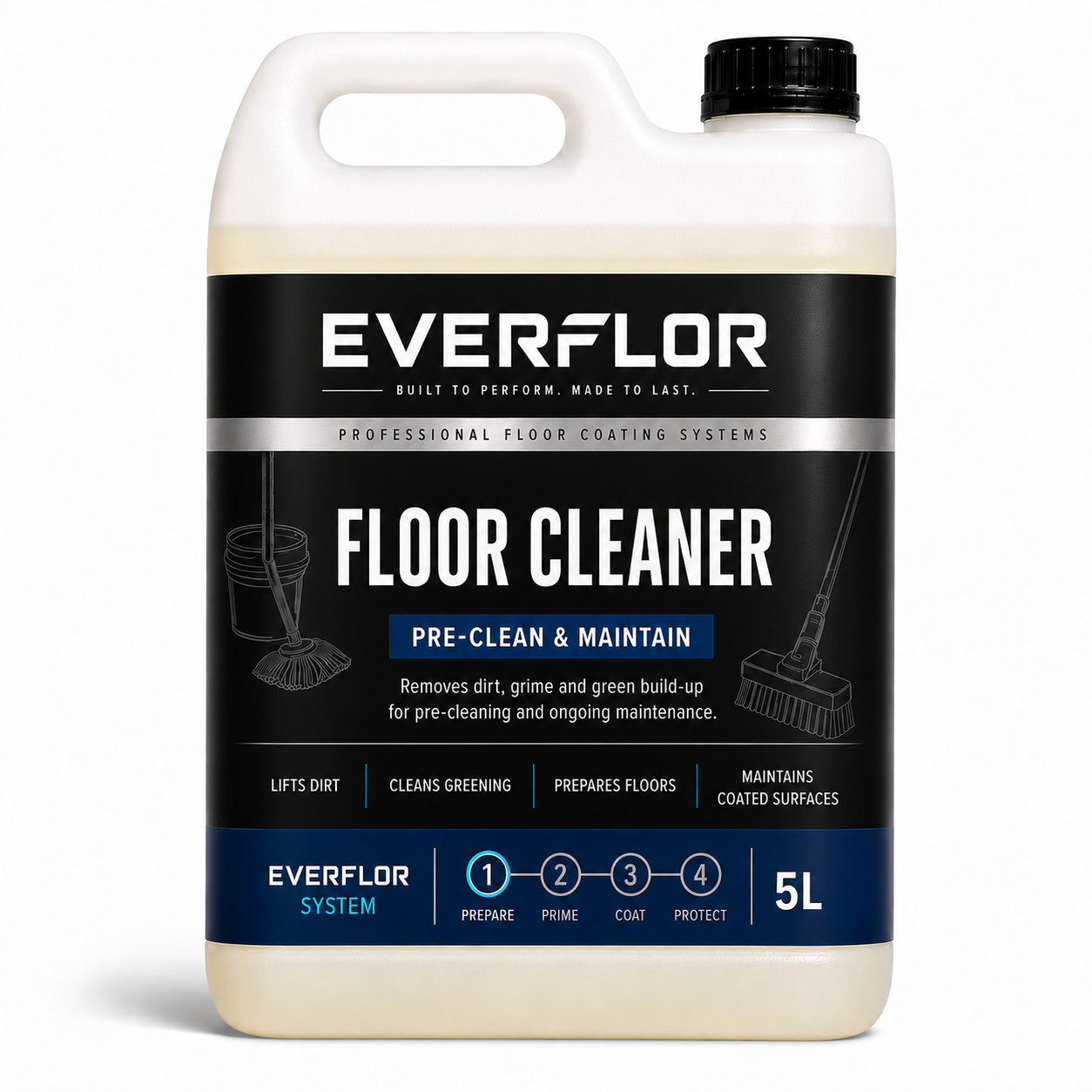
For concrete and asphalt floors, correct preparation is critical to coating adhesion and long-term system performance. Floor cleaners and etch for concrete and asphalt are used at the pre-coating stage to remove contamination, open the surface profile, and establish a suitable mechanical key prior to primers and resin-based floor paint systems.
The EVEREST Everflor preparation range is formulated for trade and industrial workflows where grease, tyre residue, dirt build-up and laitance can compromise coating bond strength. Chemical cleaning agents break down surface contaminants, while acid etching solutions react with dense concrete to create a microscopically textured surface that improves primer and floor coating adhesion.
These products are not finishes. They are functional preparation materials designed to support the performance of subsequent floor primers, sealers and high-build coating systems.
Suitable Substrates & Surface Preparation
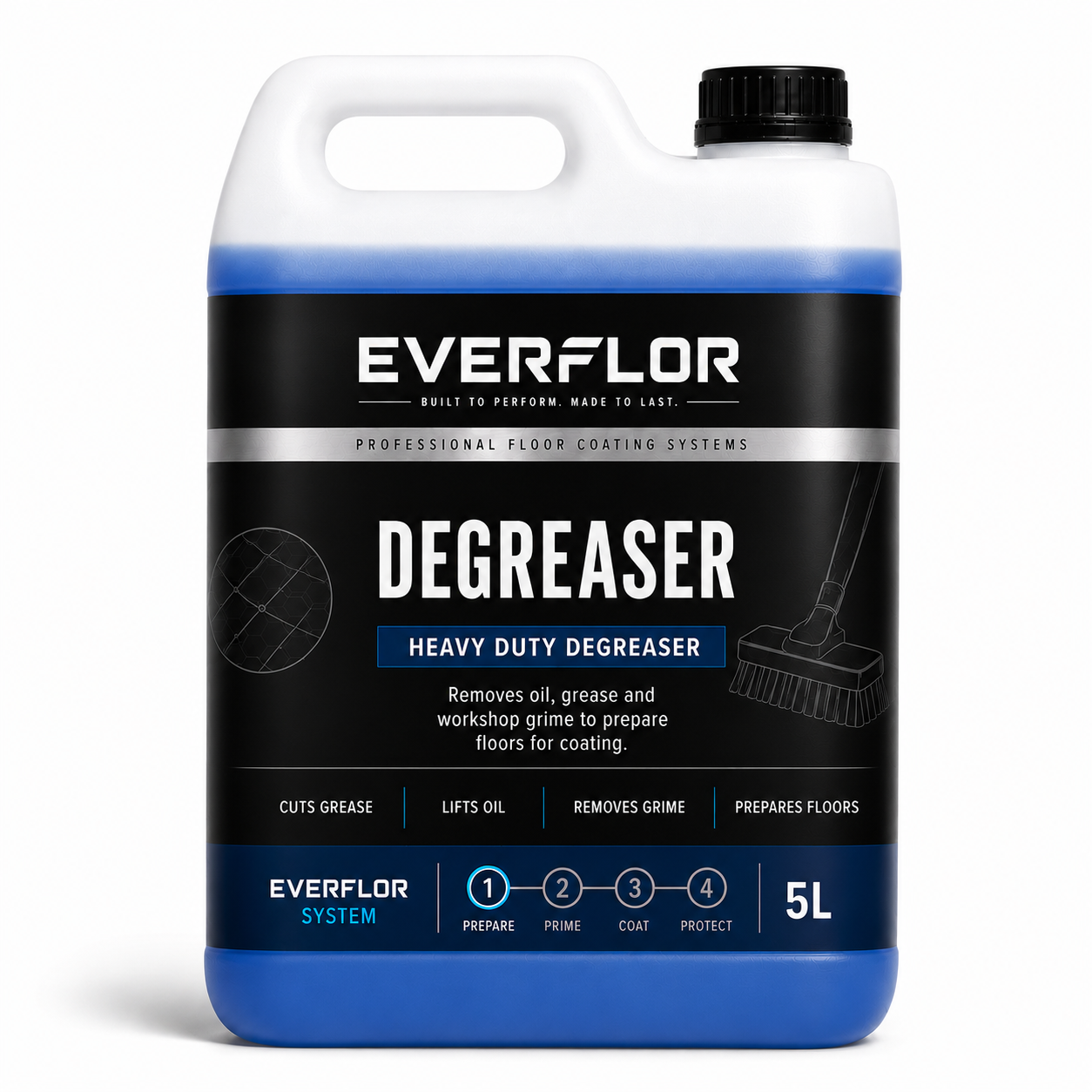
Concrete and asphalt substrates must be structurally sound before any cleaning or etching begins. On concrete floors, surface contamination such as oil, curing compounds, dirt and previous residues must be removed using appropriate degreasing cleaners. Mechanical agitation is often required to lift embedded contamination from the pore structure.
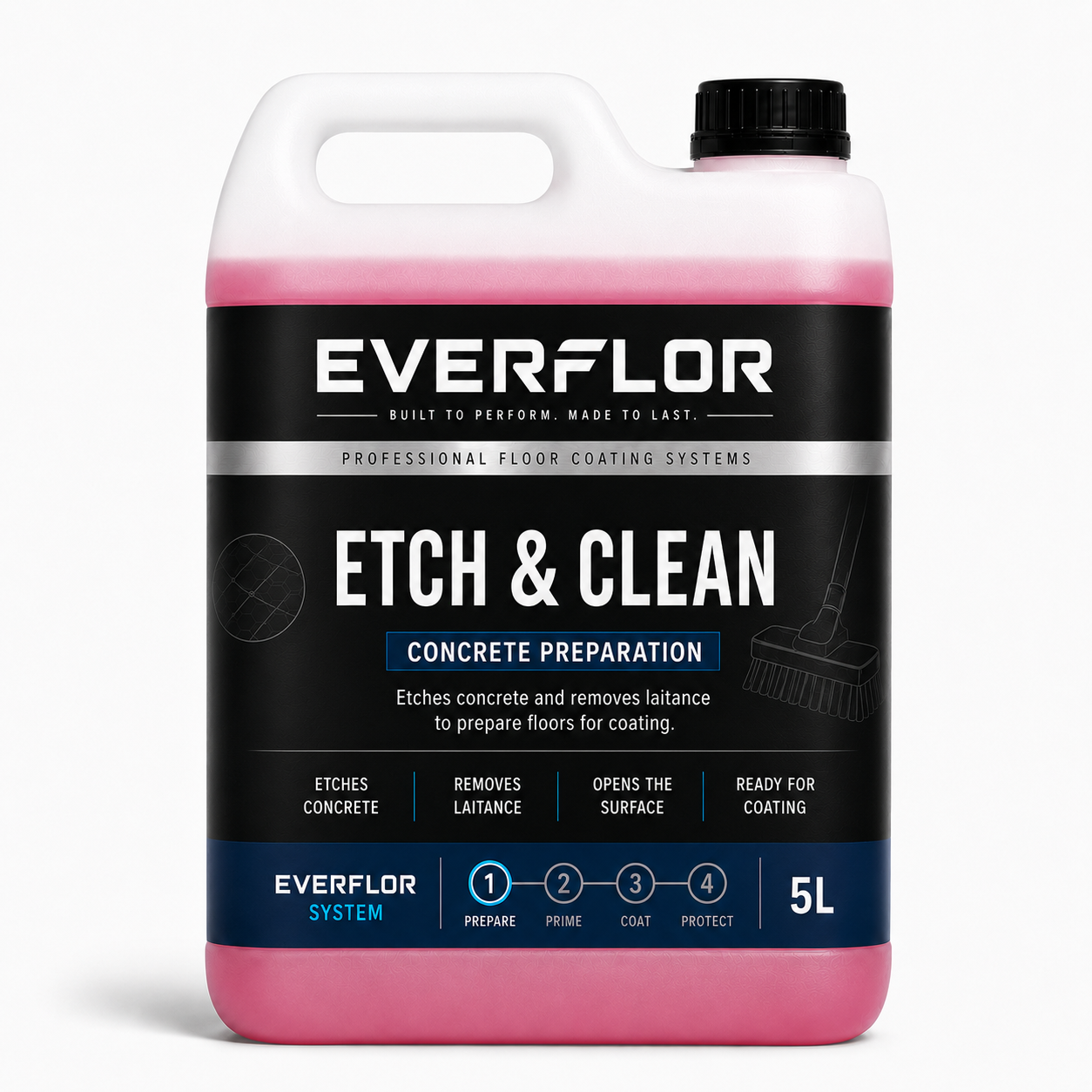
Acid etching is suitable for bare, unsealed concrete where the objective is to lightly profile dense or power-floated surfaces. The reaction removes surface laitance and creates a textured profile to assist adhesion. However, acid etching is not effective on previously sealed, coated or contaminated substrates where the acid cannot penetrate uniformly. In such cases, mechanical preparation methods may be required instead.
On asphalt floors and external hardstandings, cleaning agents are used to remove surface oils and debris prior to overcoating. Asphalt must be well bound and free from loose aggregate. Excessively soft or degraded asphalt may not provide a stable base for coating, regardless of cleaning.
All residues from cleaning and etching must be thoroughly rinsed and neutralised where required. The surface must be fully dry before application of primers or floor paints.
Performance Characteristics & Limitations
Chemical cleaning agents are designed to remove grease, dirt and surface contaminants that interfere with coating adhesion. Their performance depends on dwell time, agitation and the level of contamination present. Severely oil-saturated concrete may require repeated treatment or specialist degreasing systems before a coating-ready surface can be achieved.
Acid etching solutions improve mechanical key on dense concrete but do not repair weak or friable substrates. They will not strengthen poor-quality concrete, nor will they compensate for structural cracking or moisture-related defects.
These products do not provide protective, decorative or sealing properties. They form part of a broader floor coating system and must be followed by compatible primers and finishing coats. Failure to adequately prepare the substrate is a common cause of coating delamination, blistering and premature wear.
Environmental conditions also influence preparation outcomes. Low temperatures can slow chemical reaction times, while high temperatures may accelerate evaporation, affecting working time and uniformity.
Internal vs External Considerations
In internal environments such as garages, workshops, warehouses and commercial floors, ventilation and containment of rinse water must be considered during cleaning and etching. Care should be taken to prevent contamination of adjacent surfaces and drainage systems.
Externally, on driveways, yards and concrete hardstandings, weather conditions play a significant role. Preparation should not be undertaken during heavy rain or where runoff cannot be controlled. Surfaces must be allowed to dry thoroughly before primer application, particularly prior to epoxy or polyurethane floor coatings where residual moisture can affect cure and adhesion.
Asphalt substrates in external areas require additional assessment, as UV exposure and thermal movement may influence long-term coating performance. Preparation improves adhesion but does not eliminate movement-related stress within the substrate.
Selection Guidance & When to Specify Alternatives
Floor cleaners and etch for concrete and asphalt should be specified where the substrate is fundamentally sound but requires contaminant removal and light surface profiling prior to coating.
Where concrete is heavily contaminated, deeply oil-soaked or coated with existing sealers, mechanical grinding or shot blasting may be more appropriate than chemical etching alone. Similarly, where moisture levels are elevated, a compatible damp-proof primer system may be required before proceeding with high-build coatings.
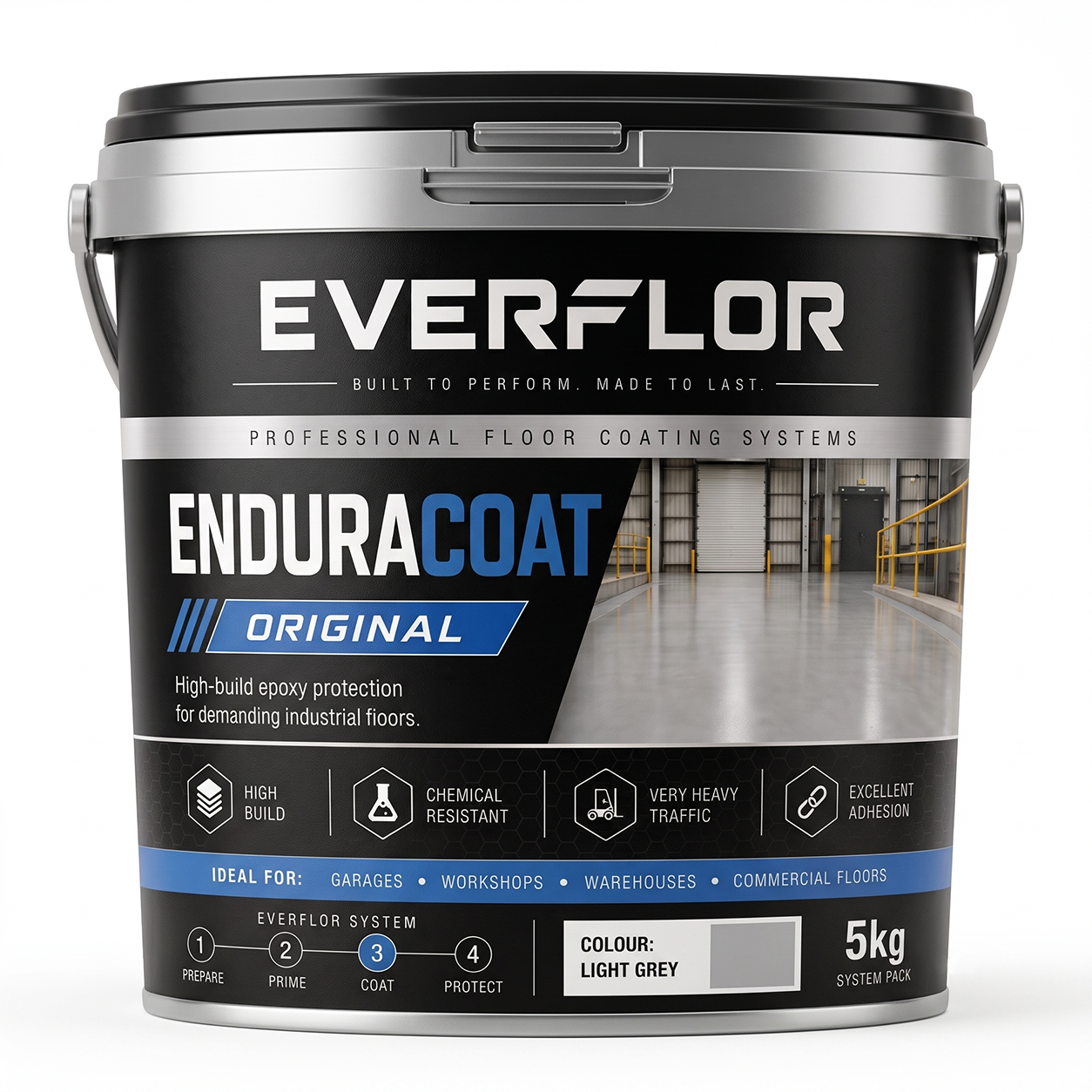
Preparation products should be selected as part of a complete system approach, including compatible floor primers and sealers followed by the appropriate epoxy, polyurethane or specialist floor coating system based on traffic level and chemical exposure.
Correct substrate preparation underpins coating durability. Chemical cleaning and etching solutions are therefore positioned as essential system components within professional floor coating specifications rather than optional accessories.