
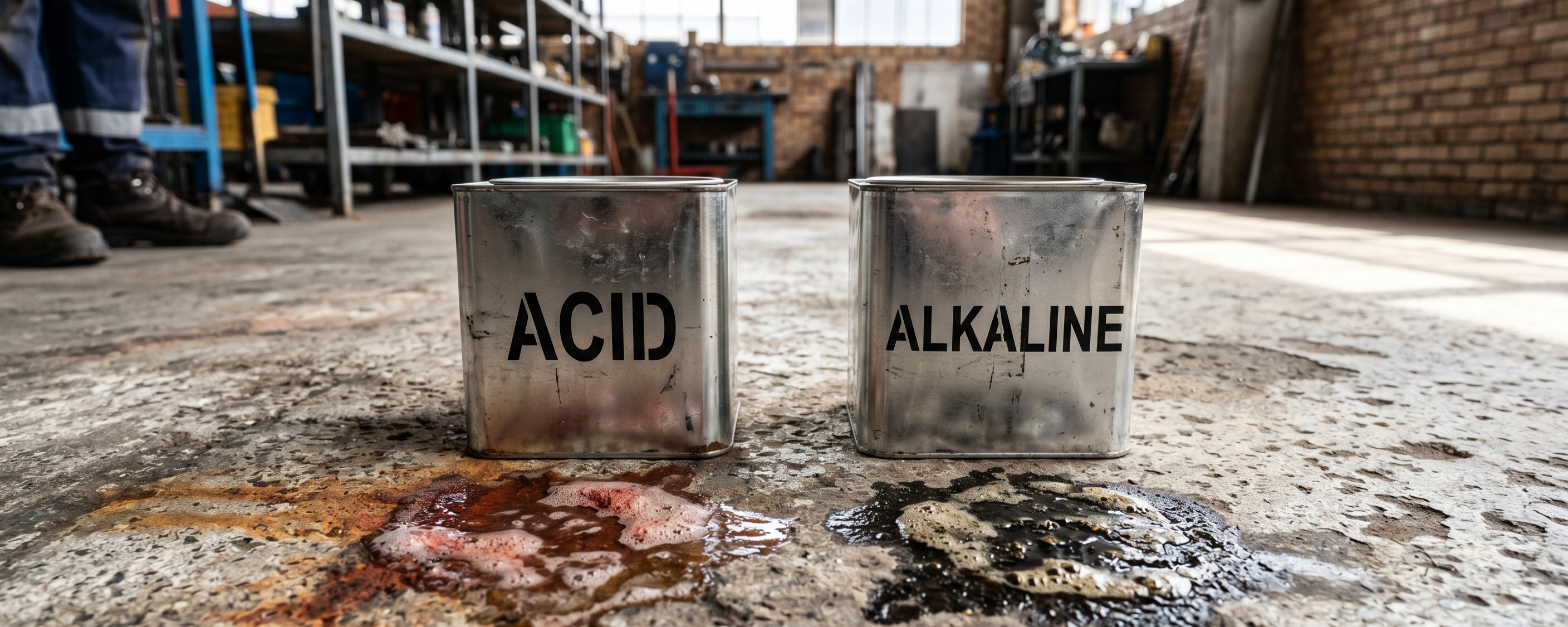
If you walk into a hardware store and ask for "concrete cleaner," you are playing Russian Roulette with your floor.
Most people grab the bottle with the most aggressive warning label, thinking "stronger is better." But in chemistry, strength isn't what matters. pH is what matters.
We see it constantly: A customer pours Muriatic Acid on an oil stain, and it does absolutely nothing (except burn the concrete around the stain). Or they use a heavy-duty degreaser to remove cement splashes, and the cement stays put.
To clean concrete successfully, you need to follow the Opposite Rule. You must use a chemical that is the opposite of the dirt you are fighting.
Here is the professional guide on when to use Acid, when to use Alkaline, and why getting it wrong can ruin your floor.
The Science: The pH Scale in 30 Seconds
You don't need a chemistry degree, you just need to know this:
-
Low pH (0-6) = Acid: Attacks minerals (calcium, rust, cement).
-
High pH (8-14) = Alkaline: Attacks organics (oil, grease, fat).
If you use an acid on an oil stain, they don't react. They just sit there. You need to match the weapon to the enemy.
1. When to Use ACID Cleaners (The "Mineral Breaker")
Acid is not a cleaner in the traditional sense. It is a dissolver. It reacts with the calcium hydroxide in the concrete itself.
Use Acid For:
-
Laitance: The weak milky layer on new concrete.
-
Cement Splashes: If you dropped mortar on your patio.
-
Efflorescence: That white, salty powder that grows on damp walls.
-
Rust Stains: Iron oxide is a mineral; acid eats it.
The Danger:
Acid "etches" concrete. It eats the top layer of cement paste to expose the sand underneath.
-
Never use strong acid on a polished or sealed floor unless you intend to strip it.
-
Never use acid on an oil stain. It will "burn" the concrete around the oil, making the stain look even worse.
2. When to Use ALKALINE Cleaners (The "Grease Eater")
If the stain came from a car, a kitchen, or a human, you need Alkaline.
Concrete Degreasers are high-pH alkaline cleaners. They work by a process called saponification - literally converting the oil into soap so it can be washed away with water.
Use Alkaline For:
-
Oil & Grease: Engine oil, hydraulic fluid, BBQ fat.
-
Tire Marks: Burnt-on rubber residue.
-
Soot & Grime: Carbon buildup.
-
Neutralizing Acid: If you have just acid-etched a floor, you must wash it with an alkaline cleaner to kill the acid reaction.
The Danger:
Alkaline cleaners are slippery. If you don't rinse them thoroughly, they leave a soap film that attracts new dirt.
3. When to Use NEUTRAL Cleaners (The Daily Wipe)
So, which one do you use for your weekly mop?
Neither.
If you wash your sealed floor every week with a high-pH degreaser, you will eventually dull the gloss. If you use an acid, you will strip the sealer.
For daily maintenance, you need a pH Neutral Floor Cleaner. This cleans the dirt without attacking the coating or the concrete.
The Cheat Sheet: Which Bottle Do I Buy?
|
The Problem |
The Chemical |
Why? |
|
Engine Oil / Grease |
Industrial Degreaser (Alkaline) |
Breaks down the fat/oil chains. |
|
White Salt / Efflorescence |
Acid Etch |
Dissolves the mineral salts. |
|
Tire Marks |
Traffic Film Remover (Alkaline) |
Lifts the rubber residue. |
|
Cement Haze / Laitance |
Acid Etch |
Dissolves the cement. |
|
Daily Dust & Mud |
Neutral Cleaner |
Safe for sealers. |
Conclusion
Before you pour anything on your floor, diagnose the dirt.
-
Is it Organic (oil, grease, food)? → Reach for the Industrial Degreaser
-
Is it Mineral (rust, salts, cement)? → Reach for the Acid Etch
If you get this wrong, the best-case scenario is that nothing happens. The worst-case is that you permanently damage your slab. Respect the chemistry.
Share:
Industrial Floor Cleaning: Manual Mopping vs. Machine Scrubbers
Acid vs. Alkaline Concrete Cleaners: Which is Best for Your Floor?