System Overview
For concrete, masonry, brick, and other mineral wall or floor surfaces, primers, sealers, and stabilisers provide the preparation stage that supports reliable coating performance. These products are applied to porous or unstable substrates before decorative or protective coatings in order to regulate absorption, consolidate friable surfaces, and promote adhesion between the substrate and the applied coating system.
Mineral substrates often exhibit variable porosity and surface strength, particularly on older masonry walls or previously untreated concrete. Without appropriate preparation, finishing coatings may dry unevenly, lose film build into the substrate, or fail prematurely due to weak surface layers.
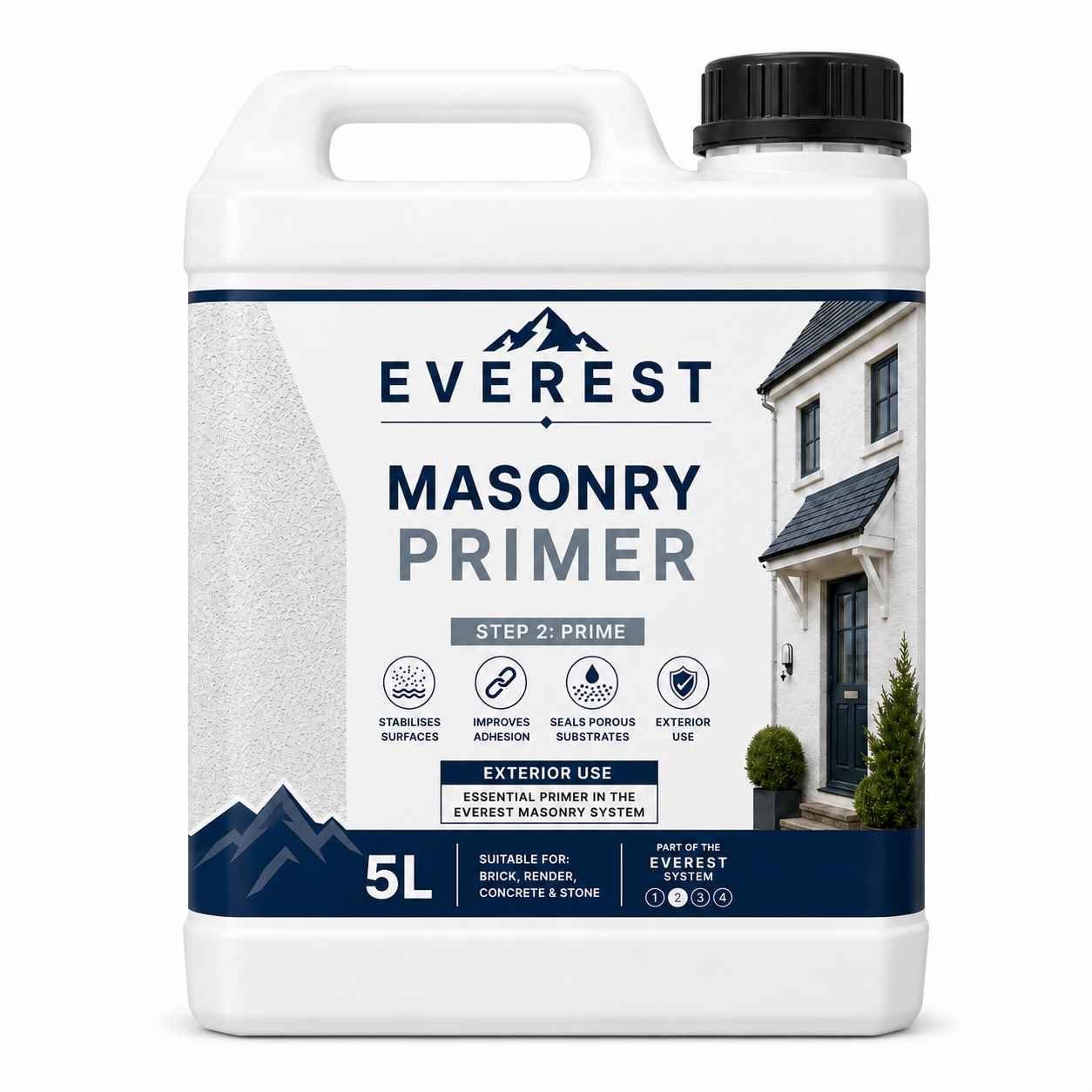
EVEREST and EVEREST Everflor primer and stabilising systems include acrylic primers, masonry stabilisers, and surface sealers designed to prepare mineral substrates for subsequent coatings. These preparation products help regulate surface absorption, strengthen friable masonry, and provide a consistent base layer for wall paints, façade coatings, or floor systems.
Primers and stabilisers therefore form an essential component of many coating specifications for masonry and concrete structures.
Suitable Substrates & Surface Preparation
Concrete, brickwork, and masonry surfaces frequently require stabilisation before the application of finishing coatings. Porous mineral substrates may absorb coatings unevenly, while weathered masonry can develop loose or chalking surface layers that compromise adhesion.
Before applying primers or stabilisers, the substrate should be clean and free from dust, grease, oil contamination, or loose material. Exterior masonry surfaces often require pressure washing or mechanical cleaning to remove environmental contamination and biological growth.
Friable or powdering masonry surfaces may benefit from penetrating stabilisers designed to consolidate weak surface layers. These products penetrate the substrate and bind loose particles together, creating a more stable base for the subsequent coating system.
Concrete surfaces, particularly in garages or workshops, may also require sealing prior to the application of floor coatings or wall paints. Primers help regulate porosity and improve adhesion of resin-based coatings applied over mineral surfaces.
Both vertical and horizontal surfaces may require different preparation approaches depending on substrate condition and the intended coating system.
Performance Characteristics & Limitations
Primers, sealers, and stabilisers perform several technical roles within coating systems applied to mineral substrates. One of their primary functions is regulating the absorbency of porous materials such as brick and concrete. By controlling surface suction, primers help ensure finishing coatings achieve uniform film formation and coverage.
Masonry stabilisers penetrate friable surfaces and consolidate weakened mineral substrates. This stabilisation reduces the risk of coating failure caused by loose surface particles or degraded masonry.
Surface sealers may also reduce dusting on concrete and provide a bonding layer for subsequent coating systems, particularly where resin floor coatings or decorative wall coatings are specified.
Despite their importance within coating systems, primers and stabilisers are not designed to function as final decorative finishes. Their role is preparatory, and they must normally be overcoated with compatible finishing coatings to provide weather resistance and long-term durability.
Internal vs External Considerations
Preparation coatings for mineral substrates can be used in both internal and external environments depending on the product type and the coating system being applied.
Exterior masonry walls often require stabilisation where surfaces have weathered or developed chalking over time. Applying stabilisers before repainting can improve adhesion and extend the lifespan of exterior masonry coatings.
Interior concrete and masonry surfaces may also require sealing prior to applying decorative wall paints or floor coatings. In garages, workshops, and utility areas, primers can help regulate substrate absorption and reduce dusting from bare mineral floors.
Environmental exposure, moisture conditions, and substrate age should all be considered when selecting an appropriate primer or stabilising system.
Selection Guidance & When to Specify Alternatives
Primers, sealers, and stabilisers are typically specified whenever mineral substrates require preparation prior to the application of decorative or protective coatings. They are particularly useful on porous masonry, weathered brickwork, and concrete surfaces where uncontrolled absorption or surface degradation could compromise coating performance.
These preparation products are commonly used on exterior building façades, interior walls, garages, warehouses, and workshop environments where coatings must bond reliably to mineral substrates.
However, where substrates exhibit severe degradation, high moisture exposure, or demanding coating requirements, more specialised preparation systems may be required. High-performance penetrating primers or specialist sealing systems can provide improved consolidation and moisture resistance for difficult substrates.
Selecting the correct preparation product should therefore consider substrate condition, environmental exposure, and compatibility with the intended finishing coating system to ensure long-term performance.