
Guides and Posts
Of Products
Help Categories
Helpful Staff
Technical Guidance & Surface Solutions
Find the Correct Preparation or Fix
Search by surface or problem to access the correct technical guide. From damp walls and flaking render to peeling paint and staining, follow the correct system for long-term performance.
- 0 commenti
- scritto da Sam Marriott
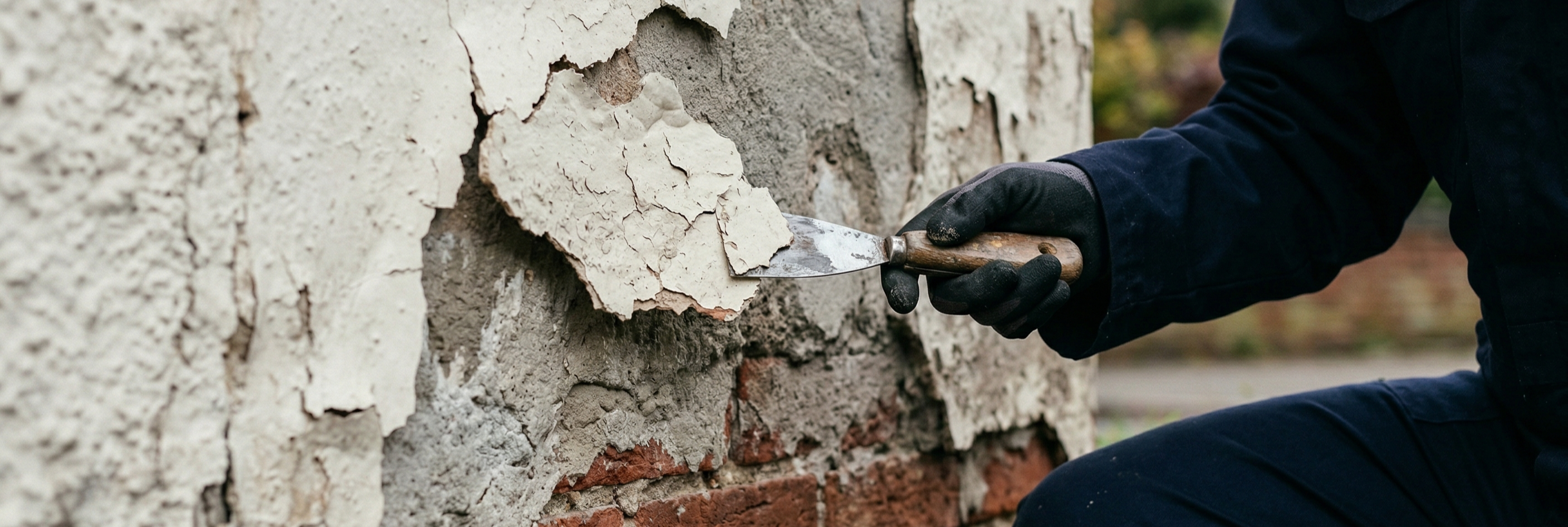
Why is My Masonry Paint Flaking Off in Chunks? | Fix & Repair
No guides found matching your search.
Try a different keyword.
For Masonry, Render & Exterior Walls
Masonry Paint Troubleshooting
Technical guides to diagnose coating failure and substrate issues across masonry surfaces. Covers damp, adhesion failure, staining and surface breakdown.
Why is My Masonry Paint Flaking Off in Chunks? | Fix & Repair
Common Masonry Coating Issues Explained
Masonry Troubleshooting FAQ’s
DAMP, MOISTURE & BREATHABILITY FAQ’s
Masonry is porous and allows moisture movement. Coating systems must be compatible with this or failure will occur.
Can I paint over a damp wall?
Standard masonry coatings should not be applied to damp substrates. Moisture within the wall will attempt to escape as vapour, and if it is trapped beneath a coating, it can cause blistering, peeling and loss of adhesion. Before painting, the source of moisture should be identified and resolved where possible. If damp cannot be fully eliminated, a breathable or moisture-tolerant system must be used.
Why does my wall stay damp?
Persistent damp can be caused by several factors including penetrating water, rising damp, poor drainage, damaged pointing or non-breathable coatings trapping moisture within the wall. Masonry naturally absorbs and releases moisture, but if this process is disrupted, the surface can remain damp for extended periods. Identifying the moisture source is essential before applying any coating system.
What happens if I use non-breathable paint?
Non-breathable coatings restrict the movement of moisture vapour. When applied to masonry, this can trap moisture behind the coating, leading to pressure build-up. Over time, this results in blistering, flaking, peeling and potential damage to the substrate itself. Breathable coatings are designed to allow moisture to escape while still providing protection.
Are there breathable masonry paints?
Yes. Breathable masonry coatings are formulated to allow water vapour to pass through while still protecting the surface from external weathering. These are particularly important for older buildings, solid walls or areas prone to damp, where moisture movement is unavoidable.
How do I fix damp-related paint failure?
All failed coatings must be removed back to a sound substrate. The source of moisture should be addressed where possible, such as repairing cracks, improving drainage or allowing the wall to dry. Once stabilised, a breathable or moisture-tolerant coating system should be applied to prevent recurrence.
PEELING, FLAKING & ADHESION FAILURE FAQ’s
Coating failure on masonry is often linked to poor preparation, unstable substrates or incompatible coatings.
Why is my masonry paint peeling?
Peeling is typically caused by poor adhesion between the coating and the substrate. This can result from damp conditions, dust, chalking surfaces, previous coatings, or insufficient preparation. If the coating cannot properly bond to the surface, it will eventually lose adhesion and peel away.
Can I paint over flaking paint?
No. Any loose or unstable coating must be completely removed before repainting. Applying new paint over a failing surface will only lead to further failure, as the underlying layer will continue to detach from the substrate.
Does render condition affect adhesion?
Yes. Weak, powdery or degraded render will not provide a suitable surface for coatings. If the substrate lacks strength, the coating will fail regardless of the product used. In these cases, the surface must be stabilised or repaired before painting.
Do I need a primer on masonry?
Primers are highly recommended, particularly on porous, chalky or previously coated surfaces. They help regulate absorption, bind loose particles and improve adhesion between the substrate and the topcoat.
What causes repeated paint failure?
Repeated failure usually indicates an unresolved underlying issue such as moisture, poor surface preparation or incorrect product selection. Simply repainting without addressing the root cause will result in ongoing problems.
EFFLORESCENCE & SALT STAINING FAQ’s
Efflorescence appears as white powdery deposits on masonry and is caused by salts migrating through the substrate.
What is efflorescence?
Efflorescence is a white, powdery residue that forms when water-soluble salts within masonry are carried to the surface by moisture. As the moisture evaporates, the salts are left behind, creating visible deposits.
Can I paint over efflorescence?
No. Efflorescence must be removed before applying any coating. If painted over, the salts can continue to migrate and disrupt adhesion, leading to coating failure.
Why does it keep coming back?
Efflorescence will continue to appear as long as moisture is present within the substrate. Without addressing the source of moisture, salts will repeatedly be brought to the surface.
How do I remove efflorescence?
Dry brushing is typically used to remove loose deposits, followed by cleaning if required. The surface must then be allowed to fully dry before any coating is applied.
Does efflorescence damage coatings?
Yes. Salt deposits can prevent coatings from bonding properly and may lead to blistering, peeling or discolouration over time.
CRACKING, RENDER DAMAGE & SUBSTRATE ISSUES FAQ’s
Structural movement, poor render condition or ageing substrates can lead to coating failure.
Why is my masonry paint cracking?
Cracking is often caused by movement in the substrate, thermal expansion, or ageing coatings losing flexibility. In many cases, the issue originates beneath the coating rather than within the coating itself.
Can I paint over cracked render?
Only after the cracks have been properly repaired. Coatings alone cannot bridge structural movement, and painting over cracks will result in them reappearing through the new coating.
What causes render to fail?
Render can fail due to moisture ingress, poor original application, substrate movement or age-related degradation. Once the integrity of the render is compromised, coatings applied over it will also fail.
Do cracks need to be repaired before painting?
Yes. All cracks and defects must be addressed before coating. Leaving them untreated will lead to continued movement and eventual coating failure.
Can coatings hide surface defects?
Some high-build or textured coatings can mask minor surface imperfections, but they will not resolve underlying structural issues. Proper repair is always required.
STAINING, DISCOLOURATION & COATING DEFECTS FAQ’s
Masonry surfaces are exposed to environmental staining, biological growth and uneven weathering.
Why does my wall look patchy after painting?
Patchiness is often caused by uneven absorption across the substrate. Differences in porosity, previous coatings or inconsistent preparation can result in areas drying at different rates, leading to an uneven finish.
What causes dark or damp-looking patches?
Dark patches are typically linked to retained moisture, contamination or differences in substrate density. These areas may absorb or hold moisture differently, affecting both appearance and coating performance.
Can stains bleed through masonry paint?
Yes. Certain stains, such as water marks, rust or organic contamination, can bleed through coatings if not properly treated or sealed beforehand.
Why has my paint discoloured over time?
Discolouration can occur due to UV exposure, environmental pollution, biological growth or moisture-related issues. Over time, these factors can degrade pigments and affect the overall appearance.
How do I achieve an even finish?
Consistent surface preparation is key. This includes cleaning, repairing defects, applying a suitable primer where required and ensuring even application of the coating system.
The Help & Technical Hub
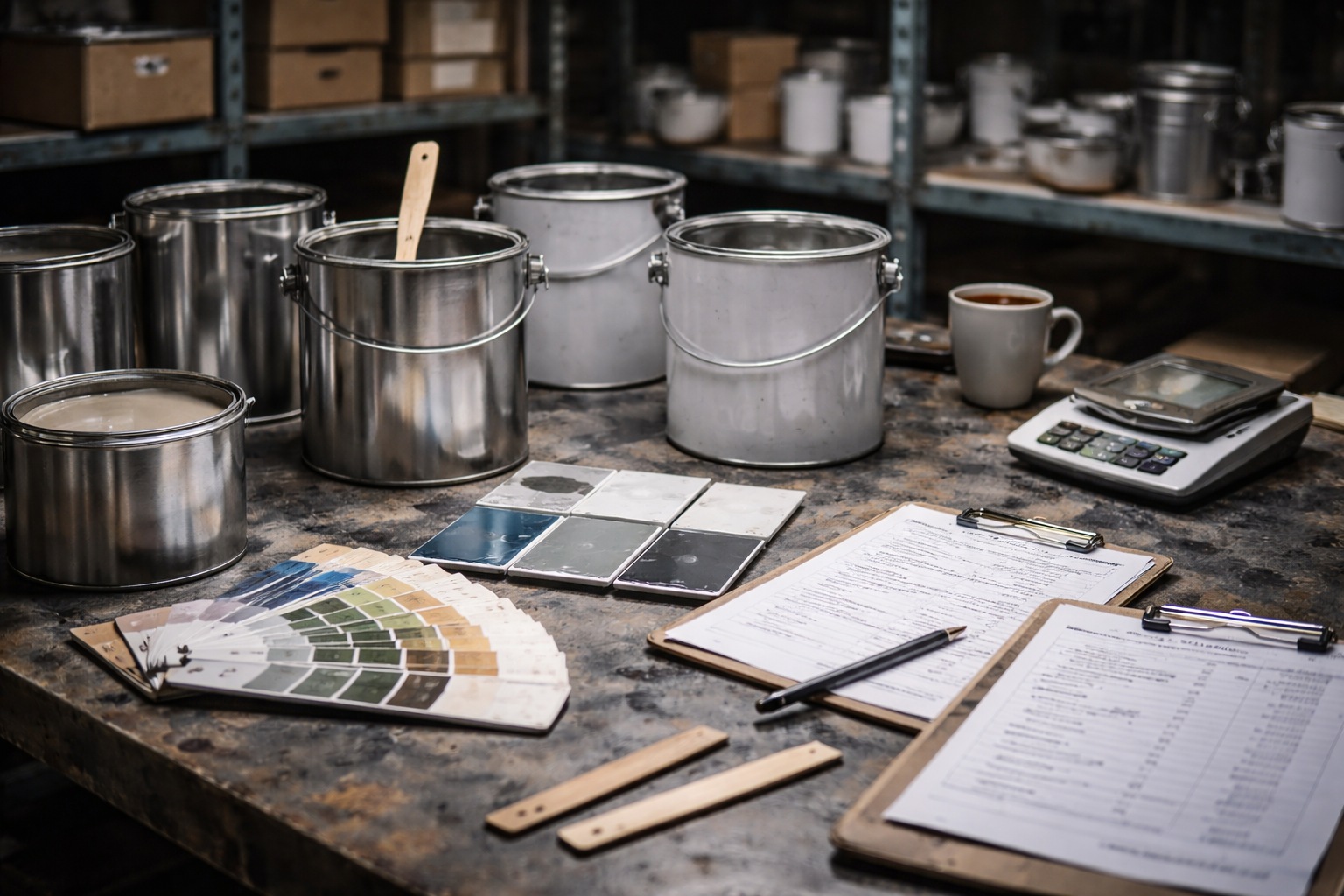
Our coatings are backed by more than just performance — they’re supported by clear documentation, practical guides, and real technical support.
The Help & Technical Hub brings together preparation guides, application advice, FAQs, SDS & TDS downloads, and system recommendations to help you choose, apply, and maintain the right coating with confidence.